United Kingdom
 USA
USA

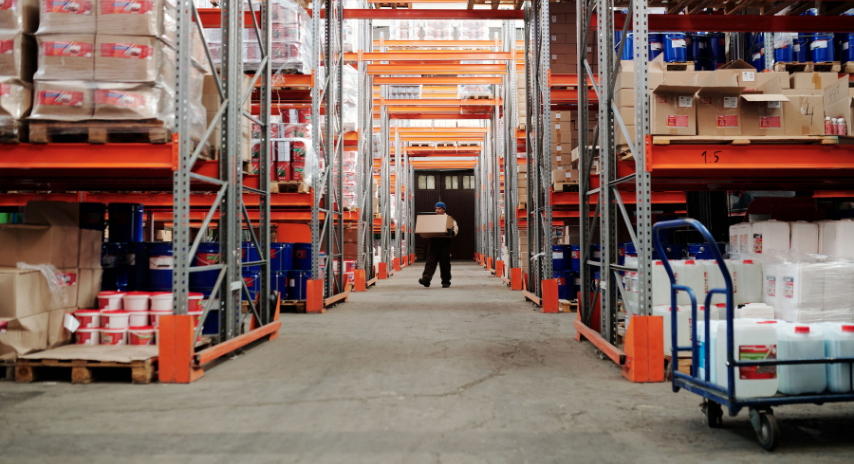
Warehouses can present a wide range of ergonomic challenges. If these risks are not identified and managed effectively, they can contribute to musculoskeletal disorders (MSDs), discomfort and lost productivity.
Depending on current risk exposure, improving warehouse ergonomics may require the combination of many different areas of focus. Nurturing ergonomics awareness among staff is of course crucial, but likely not the only area that needs attention.
Here we provide guidance on improving ergonomics standards in a warehouse, highlighting hazard areas that may need addressing and key actions to manage risk.
Carry out regular ergonomics risk assessments
Regular ergonomics risk assessments can help you identify where employees may be exposed to unnecessary physical strain and determine what changes could reduce the risk.
In a warehouse environment, assessments may need to consider:
- Manual lifting and carrying
- Repetitive movements
- Awkward postures
- Reaching and stretching
- Pushing and pulling
- The weight, size and shape of loads
- The frequency and duration of tasks
- Workstation and picking heights
- The use of equipment and lifting aids
- The layout of storage and working areas
It is important to look beyond individual tasks and consider how employees actually work throughout their shift. A task that appears low risk when viewed in isolation may present greater exposure when repeated hundreds of times each day.
Assessments should also be reviewed when there are changes to processes, equipment, workloads or the warehouse environment. This helps ensure that new or changing risks are identified and managed.
Technology can help organisations manage this process more consistently, particularly where large numbers of tasks or employees need to be assessed.
Healthy Working Pro provides a centralised approach to managing ergonomics in industrial work environments. Assessors can use the software onsite via a tablet or laptop, inputting findings directly into one of 13 ergonomics tools. Data is automatically saved and transposed into standardised report formats, helping organisations manage ergonomics risk more quickly.
Involve warehouse employees in identifying ergonomic risks
The people carrying out a task every day can provide valuable insight into the challenges involved.
Employees may be able to identify awkward movements, difficult-to-use equipment or practical problems that are not immediately obvious during a short assessment.
Encouraging employees to report discomfort and raise concerns can therefore help organisations identify risks earlier and improve industrial ergonomics risk management.
It is also important to involve employees when changes are being considered. An intervention may appear effective in theory but create new difficulties when introduced into a busy warehouse environment.
For example, changing the position of a picking area may reduce reaching but increase walking distances. Similarly, introducing a lifting aid may reduce manual handling but create additional space or workflow requirements.
Taking employee feedback into account can help ensure that ergonomic improvements are practical as well as effective.
Keep ergonomics in mind when designing the warehouse layout
Ideally, ergonomics should be considered when designing or redesigning a warehouse rather than being treated as something to address afterwards.
Not only does this approach reduce risk from the outset, but it can make future adjustments less costly and disruptive, as they tend to be smaller changes.
The layout of a warehouse can influence how far employees have to walk, how often they need to reach or bend and how easily loads can be accessed.
Consider:
- Positioning frequently handled items within easy reach
- Avoiding unnecessary bending, twisting and stretching
- Placing heavier loads at appropriate heights
- Providing sufficient space to move and manoeuvre safely
- Considering the height and position of picking areas
- Minimising unnecessary carrying distances
- Designing workstations around the tasks being performed
- Considering how people, products and equipment move through the warehouse
This being said, the trend towards the just-in-case storage model in UK warehousing can make it more difficult to prioritise worker health and wellbeing through layout. For more information, see: Managing the risk of ‘just-in-case’ storage in UK warehouses’
Redesign tasks to reduce ergonomic risk
Where an assessment identifies a significant ergonomic risk, the next step should be to consider whether the task itself can be changed.
Rather than relying solely on training or asking employees to modify their behaviour, think about how the physical demands of the task can be reduced. This could mean removing unnecessary manual handling, reducing the weight or size of individual loads, changing the height at which loads are handled or reducing the distance they need to be carried.
It may also be possible to change how goods are presented to employees or redesign workstations to make tasks easier to perform. For more physically demanding or repetitive tasks, mechanical handling and lifting aids can help reduce the amount of manual effort required.
Where appropriate, automation may also provide an opportunity to reduce employees’ exposure to repetitive or physically demanding movements.
Training remains an important part of an effective ergonomics programme, but it should support good task and workplace design rather than being the only control.
Use technology to understand movement and manual handling risks
Some warehouse tasks can be difficult to assess accurately through occasional manual observation alone.
High-volume manual handling and repetitive tasks may involve complex movements that are performed quickly or repeatedly throughout a shift. Capturing and analysing these movements can provide additional insight into where ergonomic risks may be present.
Motion capture technology can help identify patterns in employee movement, including factors such as awkward postures, bending, twisting and repetitive movements.
This can be particularly useful when assessing tasks that are performed frequently, comparing different ways of completing a task or identifying where changes could reduce physical demands.
The speed at which motion capture assessments can be delivered also makes them a great way to quickly risk assess temporary warehouse workers and ensure they work as safely as your core team.
To make this level of analysis practical on the warehouse floor, solutions like Healthy Working RiskAI combine motion capture with AI-driven risk analytics. By turning complex movement data into fast, precise insights, it helps safety teams identify risks earlier and implement targeted resolutions with confidence.
If you’re unsure what your responsibilities are regarding manual handling in the workplace, see our ‘Employer’s guide to the Manual Handling Operations regulations 1992’.
Monitor whether your interventions are working
Once an intervention has been introduced, it is important to consider whether it has actually reduced the risk and whether it has created any new challenges.
Regular reassessment can help organisations understand whether:
- The level of ergonomic risk has changed
- Employees are using new equipment or processes correctly
- The intervention is practical in day-to-day operations
- Similar risks are appearing elsewhere
- Further changes are required
Build ergonomics awareness and nurture a safety-first culture
Technology, assessments and equipment can all play an important role in reducing ergonomic risk, but they need to be supported by an appropriate safety culture.
Employees should understand why ergonomics matters, how to raise concerns and how to use equipment and controls correctly. Managers can support this by making ergonomics part of everyday conversations about safety and operational improvement.
Training and awareness activities can help employees recognise potential risks, but organisations should also encourage employees to report problems rather than accepting discomfort or difficult tasks as simply part of the job.
If you’d like to learn more about safety cultures at work, including how to benchmark and improve your own, download our white paper: Measuring the Safety Climate in Organisations
Improving warehouse ergonomics – How Cardinus can help
Cardinus provides ergonomics and risk management solutions designed to help industrial organisations identify and manage workplace risks.
Healthy Working Pro supports organisations in managing their industrial ergonomics programmes, while Healthy Working RiskAI provides motion capture and risk analytics for manual handling assessments – and is available to trial for free.
Inquire about our industrial ergonomics solutions to learn how Cardinus can help you reduce risk, lower injury rates, and improve productivity across your warehousing operations.