USA
USA United Kingdom

Ergonomics is incredibly important in lab design, not just to protect productivity, but to ensure the accuracy of scientific data.
Every ache, every micro-adjustment, every fatigued pipette press has the potential to introduce subtle, compounding variability into your method. What’s often written off as a personnel concern is, in fact, a data integrity problem.
In this article, we explain why protecting your researchers from ergonomics injury directly protects your research from error, making an ergonomic lab an effective lab.
Suffering in science: The laboratory ergonomics problem
Musculoskeletal disorders (MSDs) are the most common cause of injury in lab settings, with studies reporting prevalence rates ranging from 40% to over 80% among lab professionals – dependent on their specific discipline.
One study, for example, highlights an 82% prevalence of MSDs among clinical laboratory workers. Another suggests biomedical scientists are also a high risk group, with a 77.1% prevalence rate.
Yet, these injuries remain underrepresented in ergonomic research and often underreported within institutions.
Behind that underreporting lies a cultural issue. The rigors and “grit factor” of academia are well documented, particularly within STEM and among early-career PhD graduates. Scientists are driven by precision, discovery, and dedication — values that too often translate into silent suffering.
A highly competitive job market only adds to the pressure lab workers face, quietly encouraging stoicism and prioritizing work over wellbeing. Many push through chronic pain, taking medication just to continue working. In one study, more than 60% of lab professionals admitted to taking painkillers to get through their day.
This struggle doesn’t just harm people — it can jeopardize data. When the physical cost of work is ignored, variability seeps into the science itself.
Why lab ergonomics is a scientific quality issue
The fatigue–data error loop during lab work
The compromised pipette
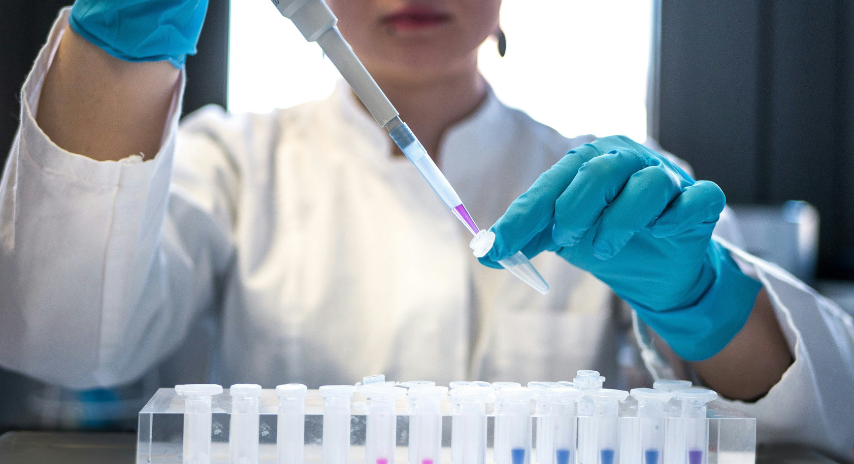
Manual pipetting demands absolute consistency in force, angle, and speed. Even minor variations affect volume accuracy, leading to poor coefficient of variation (CV) values and unreliable replicates.
When fatigue sets in from poor wrist angles, awkward bench heights, or overextended reach, fine motor control degrades. Micromovements become inconsistent, leading to subtle but real deviations in pipette performance that propagate through datasets. The numbers may still look plausible, but reproducibility collapses.
A dataset compromised by fatigue can’t be rescued in peer review — it can only be redone, at enormous cost in both time and materials.
Microscopy and the strained observer
Microscopy and image analysis demand stillness and focus, yet both can potentially be undermined by static, strained postures. Prolonged downward neck flexion and shoulder tension reduce blood flow and introduce pain-related cognitive fatigue. The brain’s attention resources are split between focusing on the image and coping with discomfort.
That split focus may lead to missed details, inconsistent classifications, and subjective bias creeping into otherwise objective analyses. Poor posture, in other words, can become a hidden variable in your experiment.
Safety and compliance: The danger of distracted hands
Awkward handling of hazardous materials
When fume hoods are too deep or benches fixed at the wrong height, scientists are forced into twisting or leaning postures to perform delicate or hazardous work.
An unstable posture increases the likelihood of spills, splashes, and cross-contamination. A single splash from a corrosive agent may injure the operator, destroy expensive reagents, damage equipment, and derail an entire experiment cycle.
The rushed or pained documentation
Pain accelerates haste. A technician eager to finish a repetitive or uncomfortable task may cut corners on documentation or labeling, not out of carelessness, but self-preservation. Yet these small lapses can cause catastrophic data failures, such as mislabeled samples, transposed figures, or irretrievable data entry errors that unravel experimental chains.
The cost of ergonomics neglect in labs
The financial burden of error
Beyond human impact, poor ergonomics is financially corrosive. Each serious work-related musculoskeletal disorder (WRMSD) claim can exceed $30,000 in direct costs alone. Add the hidden costs of lost productivity, rerun experiments, wasted reagents, and delayed publications — and the actual impact is much more severe.
Thousands of working days are lost annually to WRMSDs in laboratory environments, and each lost day has the potential to interrupt discovery.
Related – Musculoskeletal and mental health disorders in the workplace
Loss of institutional knowledge
When experienced researchers can no longer perform bench work due to chronic injury, the loss goes deeper than workforce numbers. It erases tacit knowledge, the subtle expertise that makes complex protocols run smoothly and data interpretation reliable. Losing that institutional memory slows progress in ways no funding increase can quickly replace.
Protect lab workers and scientific integrity with Cardinus
Scientific precision depends on calibrated instruments and calibrated bodies – which is where our Laboratory Ergonomics eLearning Course can help.
This CPD-accredited, fully customizable training program equips lab professionals with the awareness and knowledge to recognize, assess, and mitigate ergonomic risks in their daily work. Through interactive modules and personalized self-assessments, participants learn how to adapt their workstations, reduce strain, and prevent injury, protecting both their health and the quality of their research.
Supported by our award-winning ergonomics platform, Healthy Working, the course enables organizations to tailor learning content to individual roles and laboratory setups. The result is a safer, more productive research environment, with a workforce equipped to sustain precision, reproducibility, and discovery. Get a free trial.