USA
USA United Kingdom

Your ergonomics program may not be the first thing that comes to mind when drafting job descriptions or planning your broader recruitment strategy, but it’s more relevant (and valuable) than you might think.
When your business proactively addresses musculoskeletal health, you strengthen your employer value proposition by showing candidates that you are a “Human-First” organization that understands limitations and supports sustainable careers.
In this guide, we discuss specific instances where ergonomics can help you attract and retain top talent.
How your ergonomics program supports recruitment strategies
Tapping into a larger talent market
Around one in two adults in the U.S. lives with some form of musculoskeletal disorder1, whether that’s back pain, neck pain, joint issues, repetitive strain or something else.
In other words, 50% of the talent pool is already managing physical discomfort before they ever apply for a role, and when employers don’t clearly support ergonomic needs, exceptional candidates look elsewhere.
Experienced professionals, those with long careers ahead of them, and candidates who have learned the cost of poor support are especially attentive to these signals. Many will simply opt out before the offer stage if the organization’s approach feels reactive or underdeveloped.
Delivering on key wants and needs of job seekers
You’re unlikely to see ergonomics or physical wellbeing listed as a top priority in job-seeker surveys, not because they don’t matter, but because they’re rarely presented as standalone options.
What survey data does reveal, however, is that effective ergonomics is a foundational enabler of the criteria candidates consistently rank as most important.
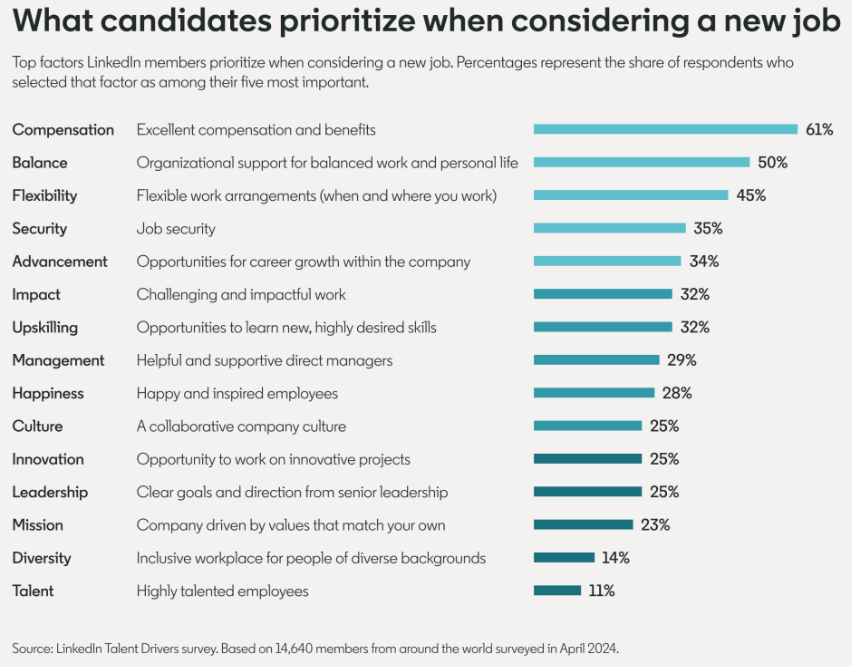
Consider the following insights from LinkedIn’s Talent Driver survey:
Source:LinkedIn
Over half of the categories candidates prioritize are all supported, and in many cases constrained, by ergonomics:
- Work–life balance (60%): Physical discomfort blurs the boundary between work and personal time, especially in hybrid roles. Ergonomics helps ensure flexibility doesn’t come at the cost of recovery and wellbeing.
- Flexibility (45%): Flexible working is only made sustainable through consistent ergonomic support and virtual assessments.
- Job security (35%): Employees who experience recurring pain or injury face greater risk of absence, reduced performance, or forced role changes, all of which undermine a sense of stability.
- Advancement (34%): Discomfort and injury can limit sustained performance over time, quietly affecting visibility, confidence, and long-term career progression.
- Management (29%): How quickly and consistently ergonomic needs are addressed shapes perceptions of managerial support and responsiveness.
- Happiness (28%): Day-to-day comfort has a direct impact on mood, energy, and engagement, influencing how employees feel about their work and workplace.
- Mission and values (23%): A visible commitment to employee wellbeing reinforces credibility around stated values and purpose.
- Diversity and inclusion (14%): Inclusive workplaces recognize that bodies, abilities, and needs vary. They design systems that support people equitably, not uniformly.
For employers competing for experienced, high-performing talent, your ergonomics credentials can serve as evidence that you can deliver on these criteria.
Ergonomics shapes the first 90 days
The first weeks in a new role are a critical part of the candidate experience and set the tone for everything that follows. Ergonomics should be a core aspect of employee retention strategy. Poorly adjusted desks, unclear processes for requesting support, or weeks-long delays for basic changes can undermine focus and engagement at exactly the moment enthusiasm should be highest.
Physical discomfort during onboarding affects productivity, confidence, and perception of the employer. High performers, in particular, notice friction early. When work feels harder than it needs to be, it reflects poorly on the organization’s operational maturity.
It’s almost a given that your top recruits have multiple offers to fall back on if they feel something isn’t quite right in your workplace, so it’s important not to give them such a clear-cut reason to start weighing up their options.
Protecting staff wherever they work
Hybrid and remote work have fundamentally changed expectations. Candidates now assume that safe, effective work setups extend beyond the corporate office. They expect clarity around home office support, consistency across locations, and an approach that doesn’t depend on being physically present at headquarters.
Organizations that can’t articulate how they support ergonomics in a hybrid environment risk appearing unprepared for modern work. In contrast, companies with a clear, scalable approach stand out as thoughtful, future-ready employers.
Where does ergonomics belong in your recruitment pitch?
A common mistake is positioning ergonomics as a perk. It’s easy to see why, as grouping it alongside benefits and workplace extras feels natural. But doing so unintentionally undermines its importance.
When ergonomics appears next to “free snacks” or “Friday happy hours,” it signals that physical safety and long-term health are optional, or subject to next year’s budget review.
To resonate with top-tier talent, ergonomics must be positioned as a core infrastructure standard. By integrating ergonomics into your operational commitment, you tell a candidate three things:
- We value longevity over burnout: We aren’t just hiring you for what you can do this quarter; we are investing in your ability to perform at your peak for years.
- We are data-driven, not reactive: We don’t wait for you to report pain. We provide the digital tools to ensure your environment is optimized from the moment you log in.
- We respect your autonomy: By providing a self-service platform, we empower you to control your own comfort, whether you are in our headquarters or your home office.
How to communicate your ergonomics approach in your recruitment pitch
The most effective way to communicate the value of your ergonomics approach is not by listing features, but by pointing to outcomes, i.e. how it improves employee experience.
Focus on what candidates care about most: stability, growth, and sustainability. Highlight indicators such as long employee tenure, low injury-related absence, consistent productivity, and positive onboarding experiences.
Explaining elements of your ergonomics program in isolation can be helpful, but tying them directly to real-world results is what makes the message credible.
Boost your recruitment drives with Healthy Working
Talent is often a business’s most competitive asset, and it should be handled with care. At Cardinus, we developed Healthy Working to help global organizations move beyond manual, reactive ergonomics and toward a scalable, software-driven culture of safety.
As part of a modern recruitment strategy, Healthy Working helps organizations strengthen their employer value proposition, improve employee experience, and reduce avoidable turnover linked to musculoskeletal risk.
Our software ensures that whether your new hire is in a skyscraper or a home office, they receive a Day One experience that is personalized, inclusive, and professional. Request a free trial of Healthy Working.