USA
USA United Kingdom

Lone workers face elevated risk simply due to their being alone while carrying out their duties. Whether working from a home office, behind the wheel of a vehicle, or out in the field, without team members present to offer support before, during or after an incident, things can and often do go very wrong. It’s therefore crucial that orgnizations implement stringent lone worker protections.
However, data shows that part of the reason lone working is currently so dangerous is that there is often a failure to realise or report when it is happening, and this applies to both employers and employees. This is why we feel it’s important to cover the basics in this guide.
Below, we explain what a lone worker is, explore the risks typical of working alone, and assess the scale of lone worker safety issues across the US.
What is a lone worker?
A lone worker is an employee who carries out work-related duties in isolation from other colleagues, without direct or close support or supervision. This includes those who work at fixed sites, mobile workers, and those working from home, where they are unable to obtain immediate assistance from a colleague in the event of an emergency.
Lone working is common in many sectors. Examples include security staff on isolated shifts, engineers and maintenance workers attending sites alone, delivery and transport workers, healthcare and social care staff undertaking home visits, and employees responsible for opening or closing business premises.
How many lone workers are there in the U.S.?
It’s estimated that there are 35 million lone workers in North America1, but it’s hard to confidently settle even on a rough estimate due to gaps in realised and/or reported lone working.
Conceptually, lone working couldn’t be more simple, yet there is often still confusion as to when work is technically classed as lone working and, in turn, when employees are classed as lone workers.
Recent research suggests that there could be up to 22 million “hidden” lone workers in the US, where employees are working on their own but are not identified as lone workers by employers or simply do not realize or consider themselves lone workers.
Those who do not realize that they are lone workers are those who do not fully understand the precarity of their working conditions. The resulting unpreparedness vastly increases their risk exposure.
It’s possible that part of the problem is that employers and employees assume that a “lone worker” is someone who is alone for the entirety of their duties, when, in fact, someone who only performs certain tasks alone is still classed as a lone worker.
As a result, lone working is likely significantly underreported, leaving millions of workers without the protections typically associated with formally recognised lone worker roles.
Lone worker risks – what employers and employees need to know
Lone working presents a unique set of risks, largely due to the absence of immediate support or supervision. In many cases, incidents that would be manageable in a team environment can become significantly more serious when a worker is alone.
Common risks faced by lone workers include:
- Accidents involving equipment or machinery
- Medical emergencies
- Environmental hazards
- Delayed emergency response
In addition to physical dangers, lone workers may also face an increased risk of violence, particularly in public-facing roles, as well as psychological risks such as stress, isolation, and poor mental health.
Related – 5 data-backed reasons to prioritize mental health at work
Lone worker risks aren’t restricted to high-risk industries
Lone working risks are not limited to traditionally high-risk industries. Any role that involves periods of working alone, whether in maintenance, transport, healthcare, or even home working, can expose employees to heightened vulnerability if appropriate safeguards are not in place.
Around 20% of employees now work alone for at least part of their day, highlighting how widespread lone working has become. Among surveyed lone workers, high-risk environments are common, with hazards such as heavy machinery, high voltages, and fire frequently cited.
What specific incidents are associated with lone working?
69% of surveyed lone workers reported injuries linked to explosions2, making it the most significant cause of injury. Vehicle-related incidents accounted for 15%, while workplace violence, including assault, affected 8% of respondents2, underlining the importance of considering both physical and external threats.
Beyond immediate physical risks, the data also highlights broader wellbeing concerns. Lone workers are significantly more vulnerable to poor mental health, with studies indicating they are over twice as likely to report struggles with mental health compared to non-lone workers. This is reflected in the fact that 23.6% of workers identify mental health support as a key need2.
Related – 5 tips for raising awareness for mental health in the workplace this May
The importance of training for lone worker safety
A range of measures can be used to support lone worker safety, including monitoring systems, scheduled check-ins, communication tools, and emergency response solutions. While these controls are important, they are only effective when underpinned by one critical element: training.
Training is the foundation of lone worker safety. Without it, employees may not recognise when they are working alone, understand the risks they face, or know how to respond effectively in an emergency. Even the most advanced safety systems rely on workers knowing when and how to use them.
This is reinforced by the data. When asked what support they value most, lone workers themselves identified safety training as the top priority, with 28.7% selecting it above all other options2. This places training ahead of measures such as personal protective equipment, check-in systems, and communication tools.
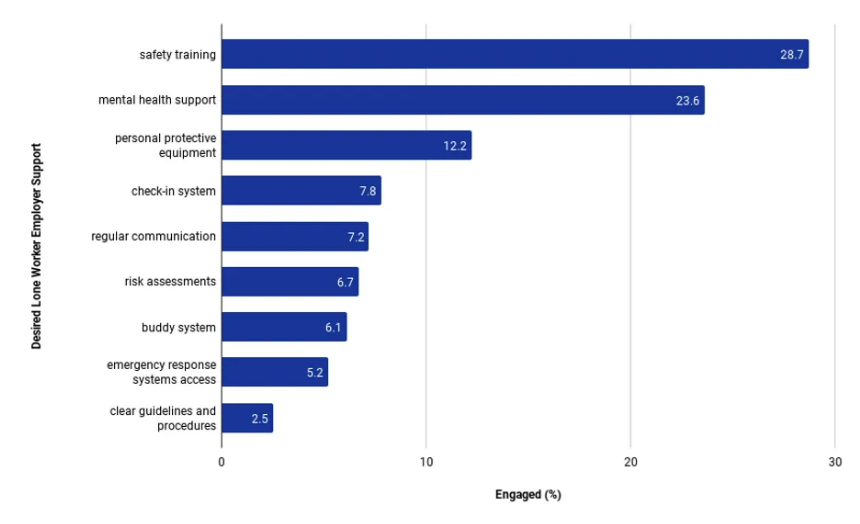
Source: Bodytrak
Support your lone workers with Cardinus
Build safer, more confident lone workers from the ground up with Lone Worker Training from Cardinus, just one of the options in our suite of Security Training courses.
Our Lone Worker training can be delivered in-person by our nationwide network of expert instructors, or virtually, depending on the nature of your business, employee work patterns, and the risks they’re likely to face. Contact us today to discuss your requirements.
Citations
- Lone Worker Landscape Report – EcoOnline
- Lone Worker Statistics Worldwide 2024 – Bodytrak